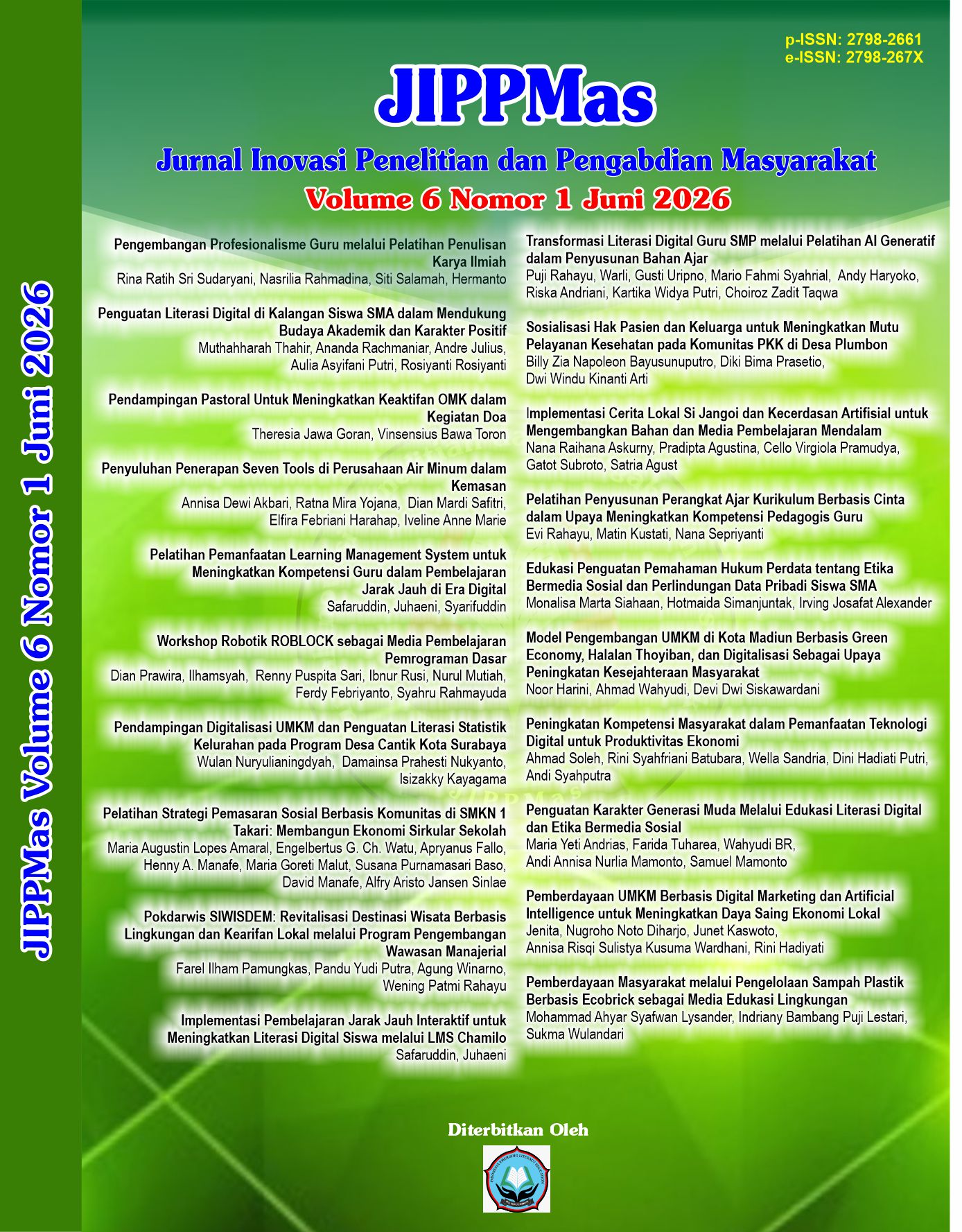
Pelatihan Pemanfaatan Learning Management System untuk Meningkatkan Kompetensi Guru dalam Pembelajaran Jarak Jauh di Era Digital

Abstract
Transformasi pendidikan digital menuntut guru memiliki kompetensi dalam mengelola pembelajaran jarak jauh berbasis teknologi. Salah satu teknologi yang banyak digunakan adalah Learning Management System (LMS) yang berfungsi sebagai media pengelolaan pembelajaran daring secara terintegrasi. Namun, masih banyak guru yang mengalami kendala dalam pemanfaatan LMS secara optimal, khususnya dalam pengelolaan kelas virtual, penyusunan materi digital, evaluasi pembelajaran, dan interaksi pembelajaran daring. Kegiatan pengabdian kepada masyarakat ini bertujuan untuk meningkatkan kompetensi guru dalam pemanfaatan LMS untuk mendukung pembelajaran jarak jauh di era digital. Metode pelaksanaan menggunakan pendekatan pelatihan partisipatif melalui tahapan analisis kebutuhan, workshop, pendampingan praktik, implementasi LMS, dan evaluasi kegiatan. Peserta kegiatan terdiri atas 35 guru sekolah menengah dari berbagai bidang studi. Hasil kegiatan menunjukkan adanya peningkatan kompetensi guru dalam penggunaan LMS, terutama pada aspek pengelolaan materi, penyusunan evaluasi online, pengelolaan forum diskusi, dan monitoring aktivitas peserta didik. Selain itu, guru menunjukkan peningkatan motivasi dan kesiapan dalam mengimplementasikan pembelajaran digital berbasis LMS. Kegiatan ini memberikan dampak positif terhadap penguatan literasi digital guru serta mendukung transformasi pendidikan berbasis teknologi di sekolah.
 Abstract View: 126
  PDF Download: 112
References
Adedoyin, O. B., & Soykan, E. (2020). Covid-19 pandemic and online learning: The challenges and opportunities. Interactive Learning Environments, 31(2), 863–876. https://doi.org/10.1080/10494820.2020.1813180
Adedoyin, O. B., & Soykan, E. (2020). Covid-19 pandemic and online learning: The challenges and opportunities. Interactive Learning Environments, 31(2), 863–876. https://doi.org/10.1080/10494820.2020.1813180
Almaiah, M. A., Al-Khasawneh, A., & Althunibat, A. (2020). Exploring the critical challenges and factors influencing the e-learning system usage during COVID-19 pandemic. Education and Information Technologies, 25(6), 5261–5280. https://doi.org/10.1007/s10639-020-10219-y
Bond, M., Bedenlier, S., Marín, V., & Händel, M. (2021). Emergency remote teaching in higher education. Educational Technology Research and Development, 69(1), 1–35. https://doi.org/10.1007/s11423-020-09872-2
Bozkurt, A., & Sharma, R. C. (2020). Emergency remote teaching in a time of global crisis. Asian Journal of Distance Education, 15(1), i–vi. https://doi.org/10.5281/zenodo.3778083
Creswell, J. W., & Creswell, J. D. (2018). Research design: Qualitative, quantitative, and mixed methods approaches (5th ed.). SAGE Publications.
Dhawan, S. (2020). Online learning: A panacea in the time of COVID-19 crisis. Journal of Educational Technology Systems, 49(1), 5–22. https://doi.org/10.1177/0047239520934018
Garrison, D. R. (2017). E-learning in the 21st century: A community of inquiry framework for research and practice. Routledge. https://doi.org/10.4324/9781315664156
Hodges, C., Moore, S., Lockee, B., Trust, T., & Bond, A. (2020). The difference between emergency remote teaching and online learning. Educause Review, 27(1), 1–12. https://doi.org/10.1080/08923647.2020.1724008
Koehler, M. J., & Mishra, P. (2009). What is technological pedagogical content knowledge? Contemporary Issues in Technology and Teacher Education, 9(1), 60–70. https://doi.org/10.1177/002205741319300303
Martin, F., Sun, T., & Westine, C. D. (2020). A systematic review of research on online teaching and learning. Computers & Education, 159, 104009. https://doi.org/10.1016/j.compedu.2020.104009
OECD. (2020). Education responses to COVID-19: Embracing digital learning and online collaboration. OECD Publishing.
Rahman, A., Wahyuni, S., & Nurhasanah, N. (2021). Participatory training model in improving teachers’ digital competence in online learning. Journal of Education and Learning, 15(3), 450–460. https://doi.org/10.11591/edulearn.v15i3.20345
Rapanta, C., Botturi, L., Goodyear, P., Guàrdia, L., & Koole, M. (2020). Online university teaching during and after the Covid-19 crisis. Postdigital Science and Education, 2(3), 923–945. https://doi.org/10.1007/s42438-020-00155-y
Selwyn, N. (2016). Education and technology: Key issues and debates. Bloomsbury Academic.
Tondeur, J., Scherer, R., Siddiq, F., & Baran, E. (2017). Enhancing preservice teachers’ technological pedagogical content knowledge. Educational Technology Research and Development, 65(3), 555–575. https://doi.org/10.1007/s11423-016-9481-2
Trust, T., & Whalen, J. (2020). Should teachers be trained in emergency remote teaching? Lessons learned from the COVID-19 pandemic. Journal of Technology and Teacher Education, 28(2), 189–199.
UNESCO. (2021). Reimagining our futures together: A new social contract for education. UNESCO Publishing.
Copyright (c) 2026 Jurnal Inovasi Penelitian dan Pengabdian Masyarakat

This work is licensed under a Creative Commons Attribution 4.0 International License.


 Abstract viewed = 126 times
PDF downloaded = 112 times
Abstract viewed = 126 times
PDF downloaded = 112 times